For decades, workplace safety has depended on periodic health checks, safety inspections, manual observations, and supervisors’ experience. While these traditional practices remain important, they often provide only a snapshot of a worker’s condition rather than continuous, real-time insights. In high-risk environments, even a short delay in identifying heat stress, fatigue, elevated heart rate, or other health indicators can increase workplace safety risks. This is where technology is transforming modern occupational health and safety by enabling organizations to move from reactive monitoring to proactive worker protection.
An IoT-based Health Monitoring System enables organizations to continuously monitor critical worker health and environmental parameters through connected wearable devices, sensors, and intelligent monitoring platforms. Instead of waiting for visible symptoms or relying solely on workers to report discomfort, businesses can gain timely insights that support faster intervention and informed safety decisions. For industries operating in high-temperature, hazardous, or physically demanding environments, real-time monitoring can strengthen safety protocols, improve workforce visibility, and help create a more proactive approach to occupational health and safety.
From Periodic Health Checks to Continuous Monitoring
The traditional approach to workplace healthcare tends to be periodic.
The employee could get his health checked every year, prior to joining, or following an incident. This is a necessary step, but there may be some changes in the worker’s health status between two periodic examinations. Let’s say that the employee went through his health check in January. It showed that everything was fine. However, several months later, the same worker could become tired, dehydrated, overheated, or have an abnormal heart rate, among others.
This will not be identified by periodic examinations.
Health Monitoring System is another story
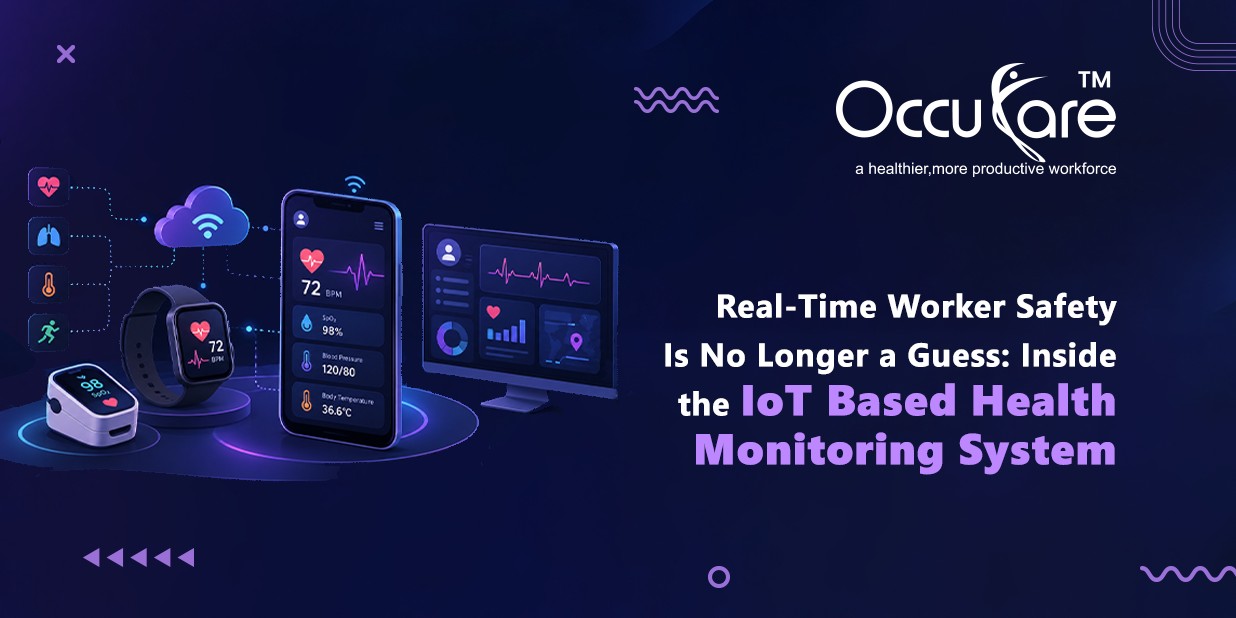
Using connected wearable devices and sensors, health-related data can be collected either continuously or at certain intervals depending on the system and devices. This data could include, but is not limited to such parameters as:
- Heart rate
- Body temperature
- Oxygen saturation
- Physical activity
- Fatigue factors
- Worker’s location/movement
- Environmental temperature
- Humidity level
- Noise exposure
And many other parameters related to the workplace environment
Afterwards, this information can be sent to the central management platform.
An IoT Based Health Monitoring System Explained
Essentially, an IoT Based Health Monitoring System involves sensors, wearables, connectivity, software, and dashboards to gather and process health data. IoT is the Internet of Things that allows communication between physical devices and software.
In the case of the workplace environment, for example, a connected device attached to the worker can gather selected health or activity data. It then sends the data via a certain network to a centralized application. The application processes the incoming data, shows certain indicators, and possibly alerts when certain criteria are met.
The overall flow could be like this:
Worker → Wearable/Sensor → Connectivity → IoT Platform → Data Processing → Dashboard → Alert/Action
It is crucial to pay attention to this connection.
Just the sensor itself doesn’t make a smart safety system. The main advantage lies in connecting the data gathered by the sensor to software, criteria, processes, and people.
It means that health monitoring can become an element of the occupational health and safety ecosystem for organizations instead of being a pure medical practice.
How Does a Smart Health Monitoring System Work?
It normally works based on several connected layers.
Data collection
First, the data collection process should be carried out. Depending on an organization’s particular needs, wearable devices and sensors will collect certain types of data. Manufacturing companies, construction sites, warehouses, or chemical factories may have their own specific needs for monitoring.
For instance, the workplace with a high level of heat exposure will pay more attention to temperature, environmental conditions, physical activity, and other factors that have to do with heat stress.
Hence, a system implementation must start with a simple question:
What exactly do we want to monitor?
In other words, technology should help us to achieve our safety goal but not become the goal by itself.
Connectivity
After data is collected, there must be a way to deliver it to the software platform. Depending on the environment, connectivity may include such technologies as Bluetooth, Wi-Fi, cellular network, gateways, or other IoT connectivity technologies.
In industrial environments, it may be difficult due to wide areas, machines, metal constructions, network restrictions, etc. Therefore, to have a reliable system implementation, one must not forget about the connectivity issue.
Data Processing
Data may sometimes require interpretation before meaning can be extracted from it.
Take, for instance, a situation where a monitoring tool has registered a heart rate of 110 beats per minute. In such a case, further information might be necessary to make sense of the figure. It might include, among other factors, the nature of activities that the worker is undertaking, the time it has taken, past rates, environmental factors, and organizational limits. In such a case, data processing would be vital. A health monitoring system can be used to arrange information and interpret it into meaningful information for users.
Alerts and Notifications
One of the most important features of monitoring tools is their capability of issuing alerts based on certain set conditions. For example, an organization can issue alerts whenever there is a certain level of environmental and worker-related factors.
The main objective of issuing alerts should not be to trigger alerts unnecessarily, as too many alerts can cause people to ignore them due to alert fatigue.
Healthcare Monitoring System Meets Occupational Safety
Healthcare monitoring is traditionally associated with hospitals, clinics, elderly care, and patient management. However, the concept has applications beyond conventional healthcare environments.
A workplace healthcare monitoring system can become part of an organization’s occupational health strategy.
For example, occupational health teams may use technology to support:
- Worker health observation
- Exposure monitoring
- Heat-stress management
- Fatigue awareness
- Emergency response
- Health trend analysis
- Medical intervention workflows
- Workplace risk assessment
- Preventive health programs
The exact application depends on the industry, workforce, regulations, and monitoring technology.
Conclusion:
Workplace safety is evolving from periodic assessments to continuous, data-driven monitoring that enables organizations to identify potential risks earlier and respond more effectively. An IoT-based Smart Health Monitoring System can help businesses strengthen their occupational health and safety programs by providing real-time visibility into worker health and workplace conditions. When combined with the right technology, safety processes, and trained professionals, continuous monitoring can support proactive risk management, faster intervention, and a safer working environment across industries.
At OccuCare, we help organizations integrate technology into their occupational health and safety strategies with solutions designed around their specific workforce and workplace requirements. Whether your organization operates in manufacturing, construction, logistics, chemicals, or other high-risk environments, the right monitoring approach can help you move beyond reactive safety practices and build a more connected safety ecosystem. Contact OccuCare today for a free demo and discover how our smart health monitoring solutions can support a safer, more proactive workplace.