Healthcare organizations manage large volumes of patient data, including medical histories, diagnoses, lab results, medications, consultations, and preventive care records. Managing this information efficiently is essential for improving healthcare operations and supporting better decision-making. AI Powered Electronic Health Record Software helps organizations manage complex health data more intelligently while improving efficiency and accessibility.
Traditional EHR systems replaced paper records with digital solutions, making patient information easier to store and access. However, as healthcare data continues to grow, businesses need smarter solutions that go beyond basic storage and visualization. AI-powered EHR solutions use intelligent technologies to streamline workflows, identify relevant information, automate routine tasks, and support data-driven healthcare decisions.
The features that can be incorporated into an existing system are:
- Patient registration and demographic details
- History of medical records
- Records of diagnosis and treatment
- Prescription records
- Laboratory and examination records
- Appointment scheduling
- Clinical records
- Medical reports
- Billing and administration systems
- User and access management
- Healthcare reporting and dashboards
This has made EHR Systems in Healthcare an important part of the digital healthcare ecosystem.
Nevertheless, normal systems usually rely on healthcare professionals for interpretation of the data and to decide what steps to take. The system functions mainly as a well-organized storage and workflow environment
What Is AI Powered Electronic Health Record Software?
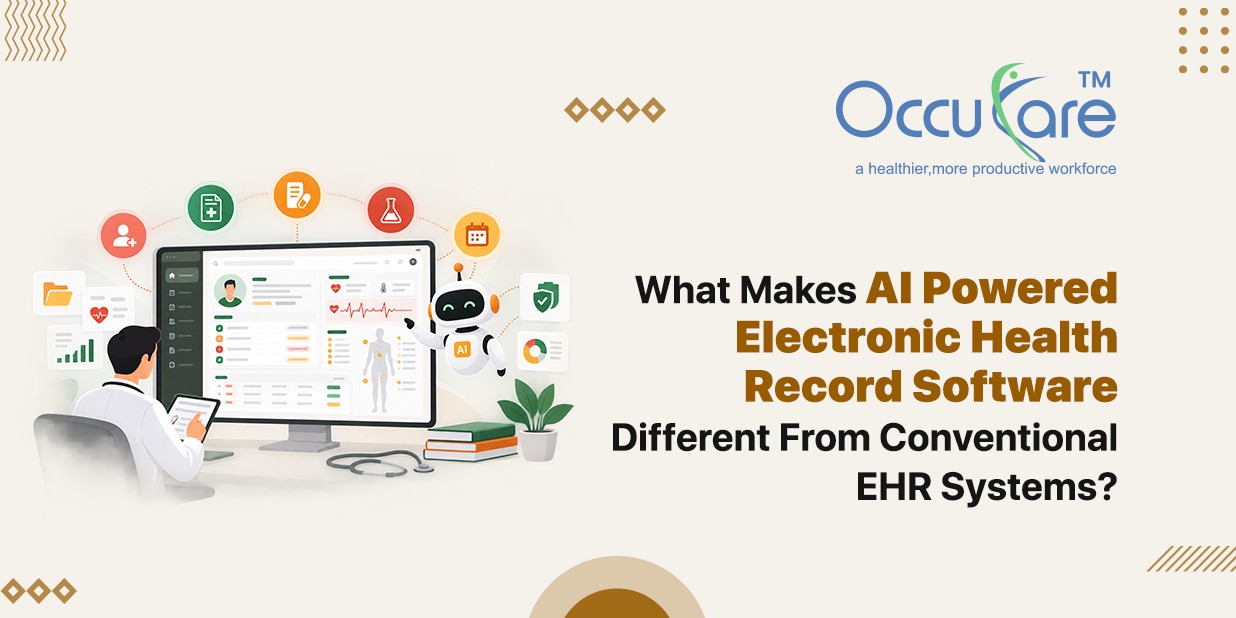
The AI Powered Electronic Health Record Software is a combination of the regular EHR features and technologies of AI and machine learning. Unlike regular EHRs that just collect the data, the AI-powered EHR can make the healthcare organizations process this data smarter. It can use its capabilities to summarize data, extract information, document, automate workflows, recognize patterns, etc., depending on its implementation.
Differences between AI EHR and Conventional EHR
1. Data Storage and Intelligent Data Analysis:
A conventional EHR is mainly meant for storing information. It requires users to search for information in the records and interpret the available data. However, intelligent systems can provide an intelligent layer on top of the information. The AI can help in finding important information and summarizing long records.
The intelligent system makes the EHR software system much more useful when working with large amounts of patient information.
2. Manual Documentation and Assisted Documentation:
Documentation is a critical element of healthcare processes; however, it may take up a lot of time. Conventional Electronic Patient Record Software typically demands its users’ manual data entry.
An artificial intelligence system could assist with the documentation process by extracting the relevant data and structuring it into a summary. The extent to which it could do that depends on the artificial intelligence technologies embedded into the software.
This would decrease the amount of administrative workload while enabling healthcare practitioners to verify the data.
3. Basic Searching as Compared to Contextual Information Retrieval:
Traditional Electronic Medical Records System Software usually provides features of searching and filtering data using the available fields and records.
An AI system can be used to employ a more contextual approach for information retrieval. Unlike using just exact keywords, the AI system can also be used to retrieve information by means of the context present in the available data.
For instance, when looking at a patient’s records, a healthcare worker might have to know about past diagnoses, medications, lab results, and consults.
4. Reactive Processes vs Proactive Help:
In most EHRs, actions are taken whenever initiated by a user. The user performs an action, searches for a record, writes a report, or completes a process.
Using AI technology, an EHR software system will become more proactive in its function by detecting trends or generating notifications according to pre-set rules and AI analysis.
For instance, an EHR software using AI may assist in identifying records that need further review or bring up information that would apply to a specific process. These features must be set with great care, as health information demands high precision.
5. Administrative Automation:
There are many repetitive tasks that need to be completed by healthcare institutions, like entering data, classifying records, creating reports, and retrieving information.
Traditional EHR systems In Healthcare have the capability of automating the predefined workflow process, but AI can even automate tasks that deal with unstructured information.
Advantages of Electronic Health Record Systems In Healthcare
The implementation of AI-powered EHR software may lead to several operational advantages when carried out appropriately.
Increased Efficiency:
The use of AI will be helpful in reducing paperwork by assisting in documentation and retrieving information.
Faster Information Retrieval:
The use of AI-powered technology will assist in searching for relevant information faster.
Better Data Usage:
Healthcare facilities generate a lot of data. The use of artificial intelligence could help turn this data into meaningful data for operational and clinical purposes.
Workflow for Personalized Patient Care:
The use of artificial intelligence will help in creating workflows depending on patient data, organization policies, and healthcare processes.
Better Reporting:
AI will help analyze data sets to spot patterns, making it easier for health care organizations to create more comprehensive reports and dashboards.
Future of EHR Software
Transition from conventional EHR software to AI-based EHR software can be considered a transition from digital data management to intelligent health information management. The significance of conventional EHR systems still lies in the fact that they are systems that allow for managing information about patients. With the help of AI, it will be possible to use this information more effectively through its interpretation, structure, search, and usage.
In other words, the future of EHR software is unlikely to be limited only to the storage of information about patients. On the contrary, modern EHR systems have to be intelligent and secure at the same time.
Conclusion:
AI-powered EHR solutions are transforming how healthcare organizations manage information, streamline workflows, and make better use of their data. By combining the essential capabilities of conventional EHR systems with intelligent automation and data analysis, organizations can improve operational efficiency while supporting more informed healthcare processes.
At OccuCare, we help businesses leverage modern digital solutions to simplify health and safety management and improve workplace healthcare operations. Contact us today for a free demo and discover how OccuCare can support your organization with smarter, more efficient healthcare management.