The Work Permit is more than simply a document in the high-stakes world of contemporary industrial operations, whether they are in manufacturing, oil and gas, or large-scale infrastructure. It is an essential communication tool, a safety net, and a legal contract. Businesses have managed these risks for decades using manual, paper-based solutions. However, the “old way” is turning into a bottleneck as operational scales increase and safety rules tighten.
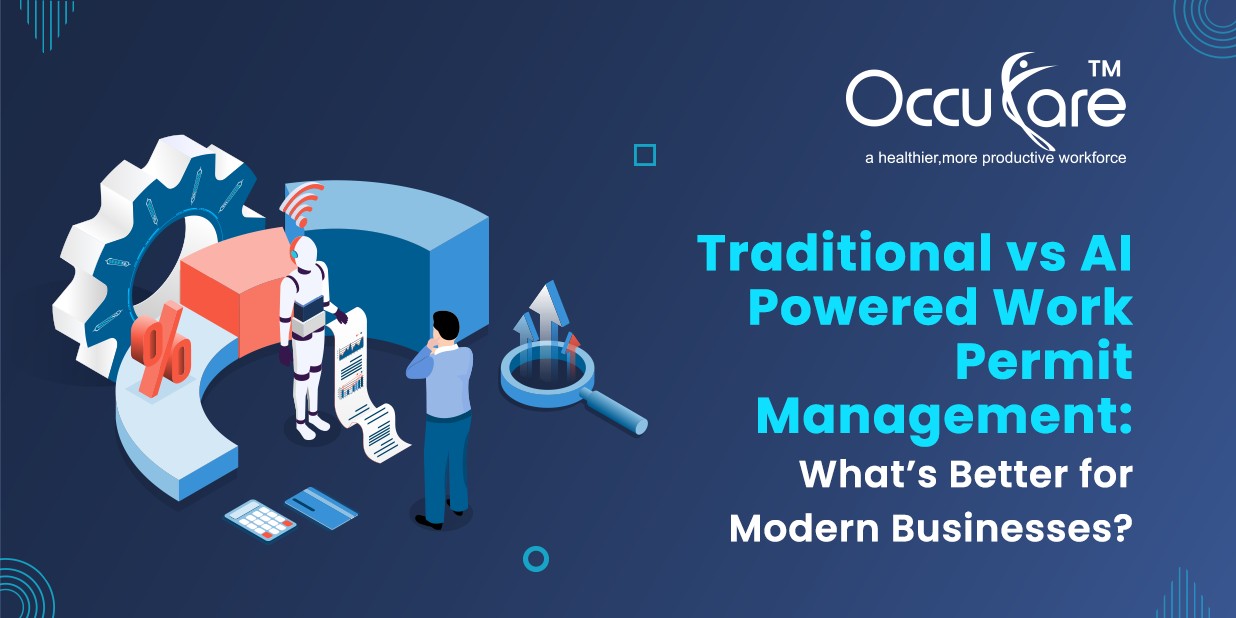
In 2026, the question facing EHS (Environment, Health, and Safety) leaders is not whether they should digitize, but rather how far they should go. Is it time to switch to AI-Powered Work Permit Management Software, or is a normal digital form sufficient?
In this in-depth analysis, we contrast conventional approaches with AI-driven innovation to ascertain which meets the demands of a contemporary enterprise.
Anatomy of the Traditional Work Permit Management System:
In the past, maintaining a work permit primarily relied on paper records and human supervision. A Work Permit Document must be physically completed by a contractor or employee who needs access to a hazardous area under this model. After that, it passes through several desks to get signatures from the site manager, the safety officer, and the area in charge.
Challenges of the Manual Approach:
- Administrative Friction: Considerable downtime may result from the time required to route a physical Work Permit Document. Work stops when management is off-site or in a meeting.
- Lack of Real-Time Visibility: In a typical system, a permit “disappears” into the field once it is issued. Until they conduct a physical site walkthrough, safety managers frequently lack real-time data on the number of high-risk jobs that are operating at any given time.
- Human error and oversight: Manual checklists are vulnerable to “tick-box fatigue.” An employee is more likely to forget a crucial safety step after signing one hundred permits.
- Storage and Compliance Issues: It’s a logistical nightmare to store thousands of physical documents for audit purposes. During a surprise inspection, it may take days to retrieve a particular permit from three years ago.
Enter the Era of AI-Powered Work Permit Management Software:
An AI-powered work permit management system collaborates with the safety officer in addition to digitizing the paperwork. These technologies turn safety from a reactive checkbox into a proactive approach by utilizing machine learning, historical data, and real-time integration.
AI’s Impact on the Game:
- Predictive Risk Evaluation: The software examines years’ worth of incident data rather than depending only on the worker’s recall. The system can automatically initiate additional safety measures if it detects that “Hot Work” carried out in “Sector 4” on wet days has historically resulted in near misses.
- Dynamic Conflict Detection: “Conflicting Work”—for instance, someone welding (Hot Work) immediately above a team handling volatile chemicals—is one of the riskiest situations on a site. All active permits are automatically cross-referenced by an AI system, which identifies any overlaps before they are even granted.
- Automated Verification: Before the permit is activated, the program can use computer vision or embedded IoT sensors to confirm that employees are wearing the proper PPE (Personal Protective Equipment).
Key Comparison: Which is Better for Modern Businesses?
Feature |
Traditional System |
AI-Powered Software |
| Speed of Issuance |
Slow (Hours/Days) |
Rapid (Minutes) |
| Conflict Management |
Manual cross-checking (High Risk) |
Automated detection (Zero Risk) |
| Data Accuracy |
Subjective / Prone to error |
Objective / Data-driven |
| Audit Readiness |
Difficult and slow |
Instant and digital |
| Safety Culture |
Compliance-based |
Proactive and predictive |
1. Efficiency and Scalability:
The conventional Work Permit Management Software serves as a ceiling for a contemporary company seeking to grow. The administrative load gets unmanageable as the number of sites and contractors rises. By automating the labor-intensive tasks of verification and routing, AI-Powered Work Permit Management Software breaks through this barrier.
2. The “Human” Aspect of Security:
AI detractors frequently claim that human judgment is necessary for safety. This is accurate, and that’s precisely why AI is better. The AI frees up the Safety Officer to spend more time on the shop floor managing high-level risks instead of shuffling paperwork by automating the tedious chores of checking dates and confirming certifications.
3. Transparency and Accountability:
It is simple to “miss” a signature or backdate a permit in a conventional system. Every action in an AI-powered digital system is geotagged and timestamped. As a result, a clear “safety trail” is produced, which is very helpful for audits and incident investigations.
Transitioning to the Future:
A change in perspective is necessary when switching from a manual procedure to an advanced Work Permit Management System. Adopting a data-driven safety culture is more important than simply purchasing software.
Actions for Contemporary Companies:
- Digitize the Document: Create a smart, mobile-responsive version of the paperwork Permit Document.
- Integrate Systems: Link your asset management system and HR database to your permit program, so you may review training records.
- Leverage Analytics: Determine which departments or contractors are more vulnerable by using the data collected by the AI to offer specialized training.
Summary:
Industrial safety operations are shifting from documentation-heavy processes to intelligence-driven ecosystems where decisions are guided by real-time data rather than manual interpretation. Work permit systems, once treated as administrative checkpoints, are now becoming central to operational risk control. Organizations that continue to rely on fragmented, paper-based, or basic digital workflows often struggle with delayed approvals, hidden safety conflicts, and limited visibility across active job sites.
By adopting AI-powered Work Permit Management, businesses unlock a proactive safety layer that continuously analyzes job interactions, identifies potential hazards before execution, and strengthens accountability at every stage. This transformation not only improves compliance but also builds a culture where safety is embedded into every operational decision. With OccuCare’s advanced solution, enterprises can move toward a connected, predictive, and fully transparent safety framework. Contact us for a free demo to see it in action.