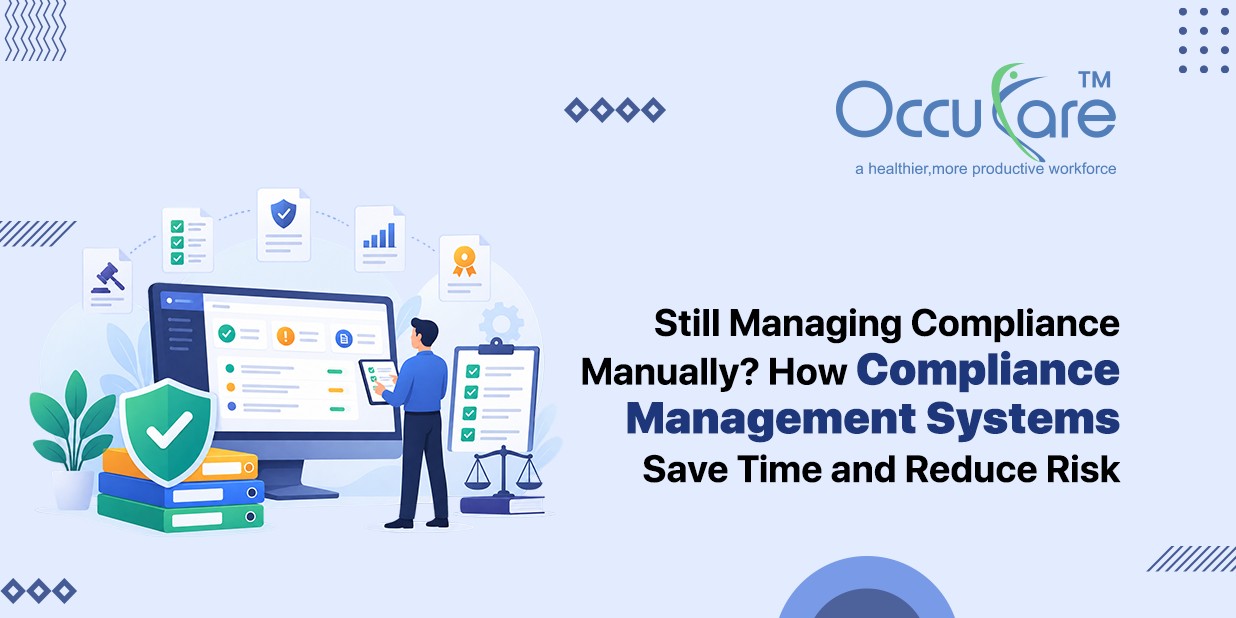
Managing compliance through spreadsheets, email threads, and paper-based records can create unnecessary administrative work and leave businesses vulnerable to missed deadlines, documentation gaps, and regulatory penalties. As compliance requirements expand across statutory obligations, internal policies, and occupational health and safety standards, manual processes can make it increasingly difficult to maintain accurate records, monitor responsibilities, and ensure consistent compliance across operations.
A Compliance Management System enables businesses to simplify regulatory compliance by centralizing documentation, automating compliance tracking, and providing better visibility into critical tasks and deadlines. By replacing fragmented manual processes with a structured digital approach, organizations can improve operational efficiency, strengthen workplace safety, and reduce compliance-related risks. In this blog, we explore the limitations of manual compliance management and how digital solutions can help businesses build a more efficient, accountable, and proactive compliance framework.
Definition of Compliance Management
Compliance management is the practice of making sure an organization adheres to the relevant laws, regulations, standards, and policies. This includes defining compliance obligations, assigning duties, monitoring operations, keeping records, and getting ready for audits. Depending on the particular industry, compliance obligations can range from health and safety at the workplace, training programs for employees, data protection, environmental regulations, financial disclosures, and many more.
The development of an efficient compliance management program provides an easy way to manage such responsibilities through defined procedures. It assists in knowing the responsibilities, measuring progress, identifying any gaps, and taking corrective actions.
The Unforeseen Troubles with Manual Compliance Management
One of the most common ways that manual compliance management can create trouble is by creating inefficiencies that reduce productivity and increase the risks faced by organizations.
1. Time-Consuming Administrative Tasks:
Employees often spend a lot of time gathering paperwork, working with spreadsheets, emailing reminders, and generating compliance reports.
2. Missed Deadlines and Renewal Dates:
Compliance tasks have specific deadlines such as licensing renewal, training for employees, equipment checks, policy review, and audits. Failure to automate reminders may lead to missed deadlines causing penalties and operational problems
3. Dispersed Documentation:
Compliance documents that are saved in emails, files shared on folders, spreadsheets, and physical files may be hard to locate. During an audit or a regulatory visit, the team may have trouble locating the latest documentation proving completion of tasks.
4. Lack of Visibility of Compliance Status:
Manually driven processes hinder the ability of managers to know the status of compliance of the organization. In the absence of a dashboard system, finding outstanding tasks, unresolved problems, and high-risk zones becomes a cumbersome process.
5. Human Error Risks:
Human errors in data entry, duplicate data, out-of-date data, and inconsistencies in reporting pose risks to compliance accuracy. Such problems could go unnoticed until an internal audit or external investigation discovers them.
These problems cannot be fixed by merely investing in administration alone. Compliance needs a technology-based solution.
How Compliance Management Systems Save Time and Mitigate Risks
With the advent of modern Compliance Management Systems, companies can easily coordinate compliance tasks using the power of technology. In lieu of disjointed software solutions, companies can coordinate their requirements, automate workflows, store documents, and track performance within one system.
1. Automate Compliance Tasks That Need to Be Repeated Again & Again
One of the best assets that comes with the digital compliance solution is automation. Users can set up reminders for their deadlines, automate inspections that need to be carried out on a regular basis, assign tasks to their respective employees, and set up alerts for those tasks that are pending.
For instance, if a workplace safety inspection needs to be carried out the coming week, users can be reminded of it beforehand. And if the task is not done, then there will be another alert generated for their respective manager.
2. Centralization of Compliance Documents
Centralizing the storage of compliance documents makes it easier to manage these documents. This includes policies, certifications, audit reports, inspection records, and evidence of corrective actions that can all be stored within an organized system.
This way, access can be made easier, and authorized users can obtain the required information without having to sift through various files and emails.
3. Enhance Risk Identification and Evaluation
Risk management is not only about task completion but also about identifying possible threats to prevent an incident from occurring.
A compliance regulatory software enables organizations to document identified risks, assess the level of their potential threat, rate them, and plan and document mitigation activities. Managers can prioritize risks depending on their severity and ensure the completion of necessary corrective steps.
4. Improving Team Accountability
Compliance obligations usually consist of a multitude of departments, locations, and stakeholders. The absence of clear accountability may lead to incomplete obligations due to a lack of knowledge about who should complete particular tasks. A digital compliance management system allows organizations to delegate duties, set deadlines, create approval processes, and track all activities.
5. Simplifying Audits and Regulatory Reports
It is always difficult to undergo an audit when all the necessary information is not gathered. In compliance management software, it will help in organizing the information needed, maintaining history, recording findings, and making reports from the available information.
This will help reduce the manual gathering of the information necessary for the audit. Though no software can make sure that an audit is successful, it will certainly make the organization ready for the audit.
Compliance Regulatory Software Selection Guide
Technology selection is critical when it comes to creating an effective compliance process. Enterprises need to assess their regulatory requirements, complexity of operations, and workflow before making a decision.
Here are some aspects to consider:
- Workflow automation: This includes reminders, task delegation, approvals, escalations, and recurring compliance.
- Document management: This involves security measures for document storage, versioning, search and retrieval of records, and appropriate access privileges.
- Dashboards and reporting: This provides status and custom reports that help management determine deficiencies and make appropriate decisions.
- Risk assessment abilities: The tool should be able to perform risk identification, risk rating, mitigation planning, and corrective actions.
- Audit trail capabilities: These provide a reliable history of activity, which helps show who did what and what the change in the record was.
- Integration capabilities: Integration with other HR, ERP, safety, and operational systems would help eliminate duplicate entries.
- Scalability: It is important to have a solution that can handle growth in terms of new facilities, new users, new regulations, and new business processes.
Apart from technical specifications, other aspects such as user-friendliness, deployment needs, staff training, data security, and maintenance should be taken into account.
Best Practices for a Compliance Management Program Implementation
Technology works best when it is backed up by solid processes and strong organization. To make a good compliance management program, an organization needs to use these best practices:
- Identification of requirements: Identify all the laws, regulations, standards, and internal policies applicable to the organization.
- Ownership definition: Specify all responsibilities of departments, managers, and employees within the organization.
- Process standardization: Standardize inspection, approval, reporting, and correction processes.
- Alert setting: Set reminders and escalate notifications based on real deadlines and risks.
- Employee training: Make sure that employees understand their roles and responsibilities.
- Performance monitoring: Analyze overdue tasks, recurrence of findings, and resolution time via management reports.
- Process update: Update processes in case of regulatory changes or changes in operations and risks of an organization.
Organizations can also monitor the effectiveness of their compliance activities within their organizations. Some of these performance indicators include the number of completed tasks on schedule, overdue corrective actions, audit observations, time spent on report preparation, and recurring compliance issues.
Conclusion:
Relying on manual processes to manage compliance can increase administrative workloads, create documentation gaps, and expose businesses to avoid regulatory and workplace safety risks. Implementing a digital Compliance Management System helps organizations streamline compliance efforts, improve accountability, maintain audit-ready records, and strengthen broader risk management. By automating routine tasks and centralizing compliance activities, businesses can improve operational efficiency, make informed decisions, and build a more proactive approach to occupational health and safety.
At OccuCare, we help businesses simplify occupational health and safety management through smarter, more structured compliance solutions. If your organization is looking to reduce manual work, improve compliance tracking, and gain better visibility into critical safety and regulatory requirements, our solutions can help you take the next step. Contact OccuCare today to book your free demo and discover how our solutions can help your business manage compliance more efficiently and confidently.