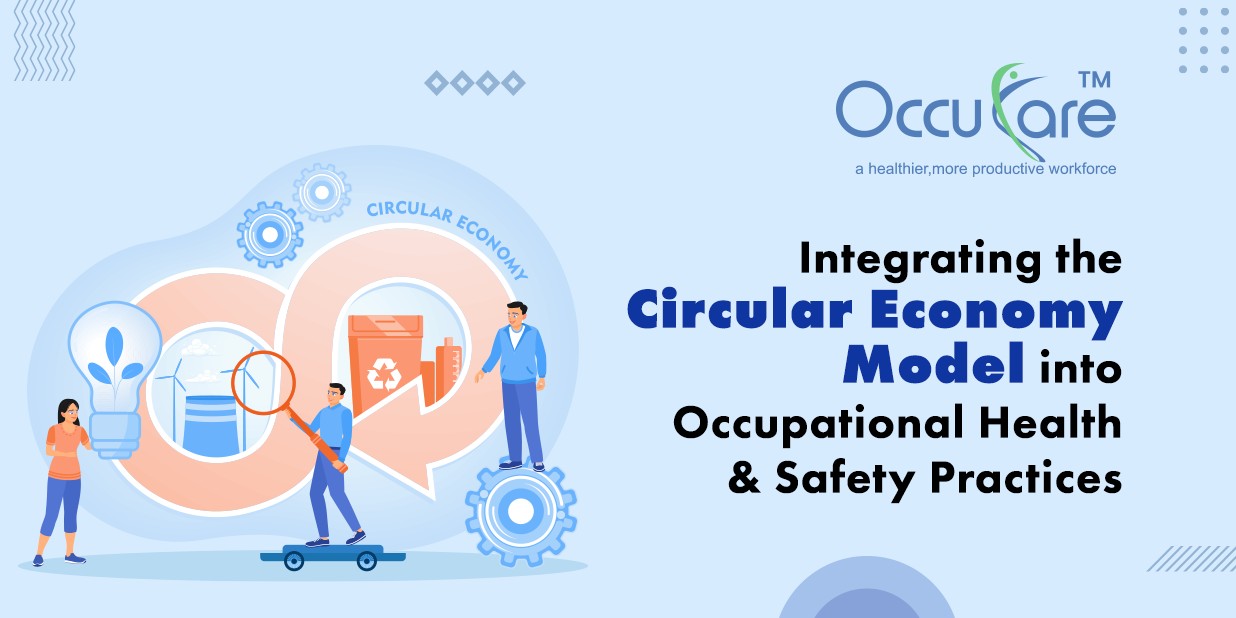
The circular economy concept is gaining popularity across companies as the globe deals with growing environmental issues and shortages of resources. Reducing waste, protecting natural resources, and developing more sustainable economic systems are the goals of this change. The dangers and opportunities for worker safety evolve along with industrial modes and material flows.
This blog examines the relationship between workplace safety and the circular economy’s tenets. It describes the possible advantages of combining the two, the new dangers of circular operations. And the doable actions that companies, authorities, and employees may take to guarantee a safe. Just, and long-lasting shift to circularity.
Significance of the Circular Economy for OHS:
Circular Economy Model main objective is to create products and processes that reduce waste and maintain resources in use by employing tools like recycling, remanufacturing, reuse, and repair. This strategy changes how workplaces function while also promoting environmental sustainability. Businesses that embrace circularity implement new procedures and materials that have the potential to completely alter working conditions and exposure hazards.
Opportunities for Improving Occupational Health & Safety:
When circularity is taken into account early in the design of products and systems, the cyclical economy offers many chances to improve worker health and safety. One of the many benefits is the idea of “preventing” through design.” Designers may reduce or remove risks before they ever reach the workplace by taking into account a product’s whole life cycle from the start. In one example, reducing worker exposure to hazardous substances can be achieved by designing items for easy disassembly and using recyclable, non-toxic materials.
The move away from high-energy, dangerous primary manufacturing methods presents another possibility. As more items are recycled, repaired, or recycled, businesses may be less dependent on hazardous activities like mining or chemical production. By doing this, workers may be exposed to less environmental, chemical, and physical hazards.
New Safety Issues and Emerging Risks:
The rising risk of unknown chemical and biological dangers is among the most worrying. Workers who handle recycled materials may be exposed to residual contaminants such as heavy metals, persistent organic pollutants, or degraded chemicals. And these products sometimes have no documentation. For example, employees in plastic recycling facilities could unintentionally come into contact with items that contain harmful flame retardants or banned chemicals.
There are also significant physical risks involved with disassembly, repair, and refurbishing. In contrast to typical manufacturing’s standardized operations, reverse processes frequently entail uncertain activities. There is a greater chance of cuts, burns. And musculoskeletal injuries when workers disassemble products that have sharp edges, corroded parts, or poorly labeled components. These dangers are increased when the wrong instruments are used or when there is insufficient ergonomic support.
The spread of informal employment arrangements in circular sectors is another issue that is becoming increasingly concerning. Workers in informal societies, where they lack access to basic rights, health services. And regulatory control, do recycling and repair services in many parts of the world. Without proper protections, these workers can be subjected to hazardous working conditions, high workloads, and depression.
Guiding Principles for Integration:
A set of guiding principles must direct the incorporation of OHS into CE initiatives in order to manage these changing problems and optimize the advantages of circular systems. Life-cycle thinking is an essential principle. From the sourcing of basic supplies to the recycling or disposal of end-of-life products. Organizations must take into account how their activities impact worker safety at each step. Negative flows like removal, sorting, and repairs must be included in testing for safety.
Second, design-based prevention ought to be embraced as commonplace. Products should be designed with the safety of people handling, fixing, or recycling them in mind, in addition to their consumer convenience and environmental impact. Modular product designs, for instance, can make repairs easier. And components with clear labels can help avoid mistakes and unwanted exposures.
Circular OHS Implementation in Practice:
Practically speaking, companies can take a number of actions to match the goals of the circular economy with workplace Health and Safety Software. To find out how circular practices may change material flows, job duties, and exposures, a baseline risk assessment must be carried out. For instance, if a business launches an electrical device refurbishment line. It needs to determine the risks related to battery removal, sharp parts, and chemical residue.
The governance structure of the organization ought to be informed by this assessment. To make sure that health hazards are taken into account alongside environmental implications. Safety professionals need to be integrated into sustainability and product development teams. Additionally, procurement guidelines must be revised to mandate safety records for components or recycled materials.
Moving from Compliance to Innovation:
In the end, integrating the concepts of the Circular Economy Model into OHS should be viewed as a chance for innovation and value creation rather than just a compliance concern. Companies will be in a better position to attract and keep skilled workers, gain confidence of the public. And adjust to changing requirements if they design for environment and safety at the same time.
Conclusion:
Integrating the circular economy into occupational health and safety practices is no longer just a forward-thinking ideal—it’s a strategic imperative. Companies that adopt sustainable safety protocols not only reduce waste. And environmental impact but also create safer, more efficient, and future-ready workplaces.
At OccuCare, we help businesses transform their occupational health and safety practices through smart, sustainable solutions that align with circular economy principles. Whether you’re just starting your sustainability journey or looking to optimize your existing OHS systems. Our digital tools and expertise can help you take the next step confidently.
Want to future-proof your workplace safety strategy? Contact us today to see how we can help you integrate sustainability into your OHS programs.